
Fundamentals
Why a hotter shell and a higher fuel bill tell different stories
Separate energy paths before explaining a temperature
Imagine a crew notices a hotter exterior patch in the same week fuel use increases. A lining change offers an attractive explanation for both observations. The furnace, however, can lose heat through its walls, openings, exhaust and cooled components. Only some of those paths pass through the patch.
Start with what each observation covers. A temperature refers to one surface under particular conditions. A fuel total covers the entire furnace for an interval. If the door was open longer or the charge was colder, the fuel total could rise even if that wall carried the same heat flow. A local anomaly could still deserve investigation in its own right.
For a fair comparison, ask when the surface reading was taken, what the furnace was doing, and how much product it heated during the fuel interval. These questions establish whether the two observations even describe the same operating state.
Put a scale on the surface observation
Consider a deliberately simple convection model. Two square metres of shell warm from 70 to 90 °C while ambient air stays at 20 °C. Suppose the effective convection coefficient stays at 10 watts per square metre per kelvin. The temperature difference grows by 20 kelvins. Multiplying area, coefficient and that increase gives 400 watts of additional convective loss. Over ten hours that amounts to 4 kWh of heat. Radiation is omitted and the air flow is assumed steady.
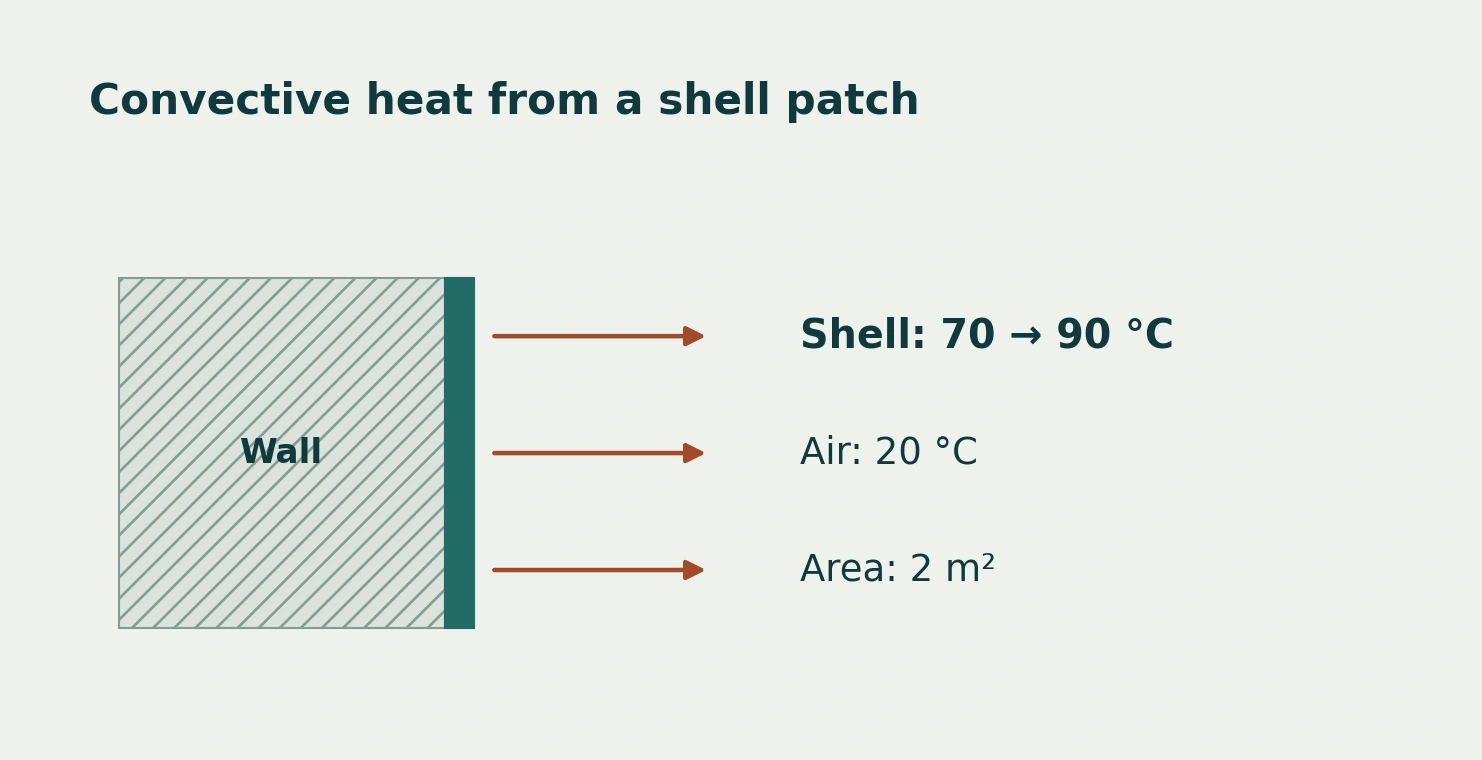
Would 4 kWh settle an argument about the fuel bill? Only if the area and the period match, and after you account for radiation and the efficiency of supplying that heat. Extrapolating this one patch across a whole furnace would introduce another assumption. A plant engineer can now ask which missing term matters most before commissioning a more detailed survey.
Test your intuition. If the local airflow doubled during the survey, could you still use the same coefficient with confidence? No. A new airflow regime can change the relationship between surface temperature and heat loss. Record the changed condition before attaching a dollar value to the image.
Rio Tinto’s Arvida recycling-centre announcement gives a real example of the system boundary: the proposed installation included regenerative burners and automated scrap loading. Both belong in a discussion of energy performance. The announcement describes equipment choices; it supplies no measurement of the shell patch or fuel saving in our example. Rio Tinto project announcement.