
Fundamentals
What ends a lining campaign?
A lining can outlive its first layer
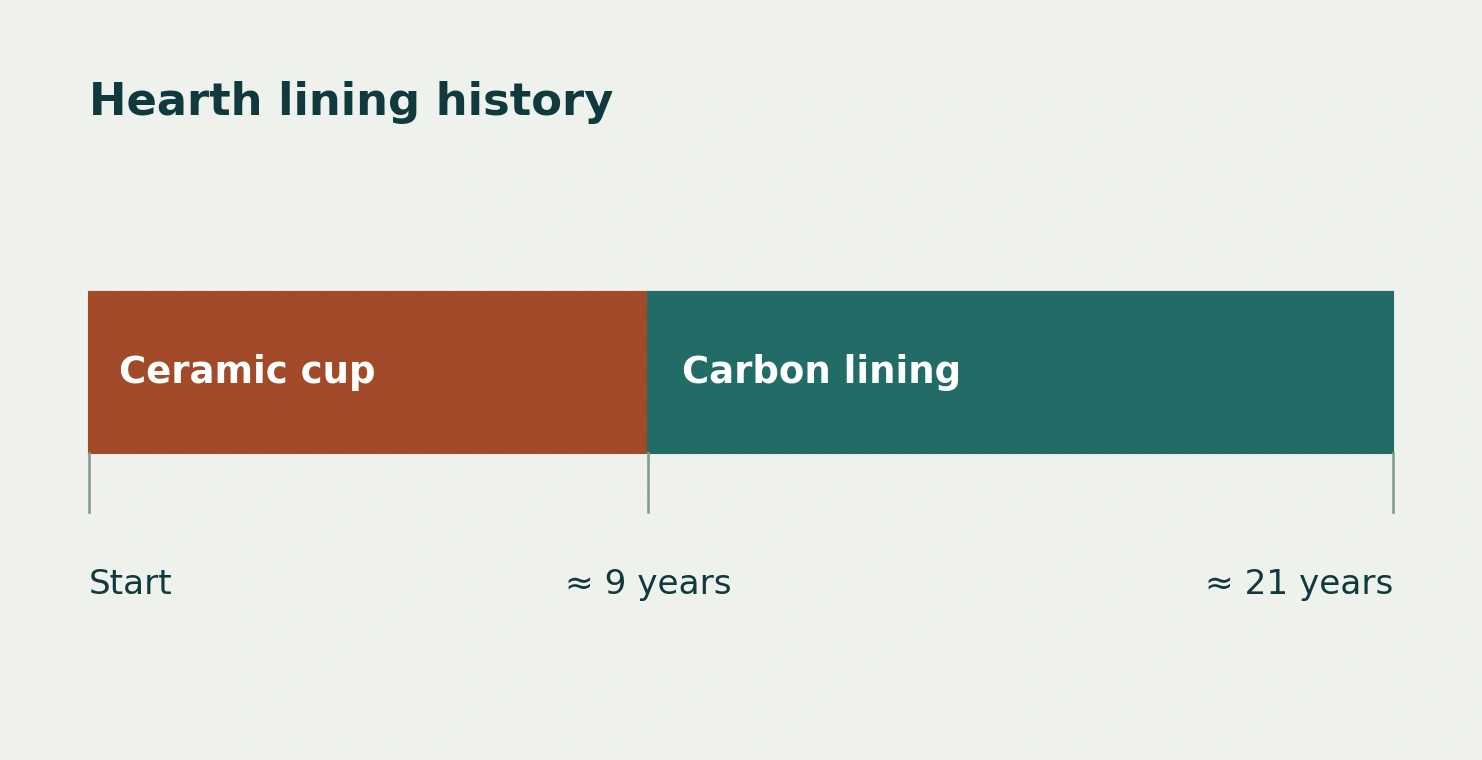
At Schwelgern blast furnace 2 in Duisburg, the ceramic cup in the hearth lasted about nine years. If you had been asked then how long the campaign had lasted, nine years would have been a reasonable answer to the wrong question. The furnace went on to produce iron for roughly another twelve years with the carbon lining.
The hearth holds liquid iron. Its lining is an assembly, and different parts of that assembly can have different service lives. In their account of the summer 2014 reline, ThyssenKrupp engineers P. Rüther and M. Peters describe almost 21 years of operation and more than 78 million tonnes of hot metal. The two periods in the diagram are their retrospective account. The boundary at year nine does not represent a measured, simultaneous loss of ceramic around the entire hearth.
What ended this campaign in the historical record was the reline. What justified choosing that particular summer is a different question. The published summary discusses design, cooling, operation and the wear found during demolition. It gives no single alarm value or final shift observation that triggered the decision. It would be easy to look at a demolition photograph and invent one.
Imagine presenting this case at year nine, before the remaining twelve years were known. A shift lead could describe what had changed during operation. An engineer could compare measurements from neighbouring locations and review the cooling history. The investment decision would turn on how confidently that evidence supported continued service until a feasible outage. The eventual 21-year result was unavailable to all three.
Try it: a neighbouring furnace also reaches nine years. What information would you want before using Schwelgern as a benchmark? Look for the lining design, cooling arrangement and evidence of local condition. A shared birthday tells you none of those things.