
Campaign performance
What the heat-loss estimate leaves out of cost per tonne
The denominator changes the commercial interpretation
A hypothetical furnace uses 120 units of fuel to deliver 100 tonnes on one day and 110 units to deliver 80 tonnes on another. Total fuel fell. Fuel per tonne rose from 1.20 to about 1.38 units. Both statements describe the same two days.
Furnace heat balances include losses through walls and openings. When throughput changes, those losses need not change in proportion to saleable output. Longer holding time or a different charging pattern can also alter the comparison. A proposed lining upgrade cannot be credited with the entire difference merely because the dates coincide.
Ask which tonnes count: charged, tapped or saleable. Then ask which operating hours and products sit behind them. Only after agreeing on that basis does a discussion of the value of reducing a particular loss become useful.
Try a two-term model
One explanation consistent with the illustrative readings is a daily holding load of 70 fuel units plus half a fuel unit per delivered tonne. At 100 tonnes the model gives 120 units; at 80 tonnes it gives 110. A fixed daily load spreads over fewer tonnes on the quieter day. The arithmetic reproduces the observations exactly.
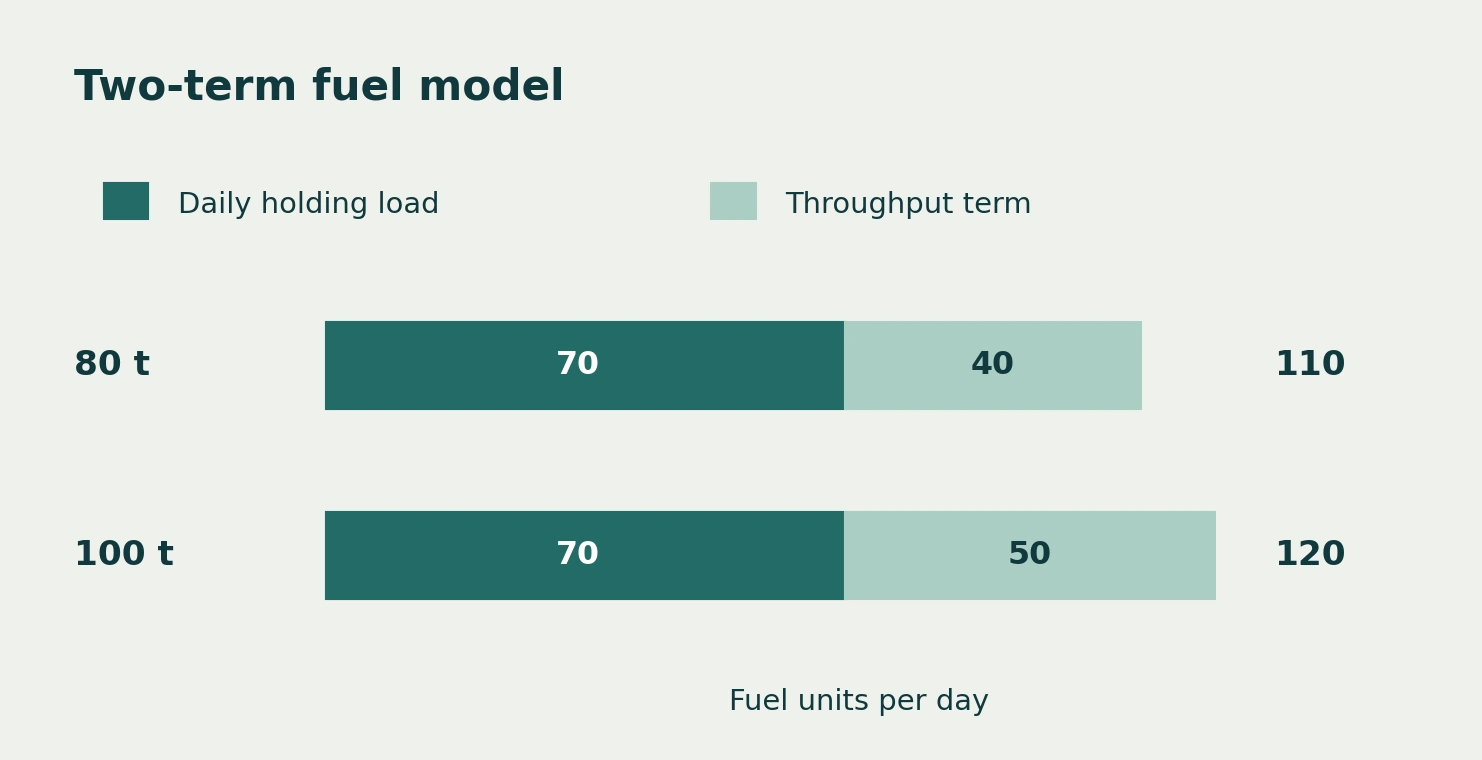
Would you use the 70-unit estimate to justify new insulation? Two observations determine both coefficients, leaving no spare observation to test the fit. Holding hours, cold starts or product mix could have changed between days. The apparent fixed term combines all those effects.
Make a prediction you can check. At 90 tonnes under otherwise similar conditions the model predicts 115 units. A large miss would send us back to the operating record. Even a close result establishes only that this simple description is useful across these days; it cannot isolate wall losses. For that, the heat balance needs independent evidence.