
Campaign performance
Can you calculate lining life from annual plant capacity?
A published capacity figure looks like a ready-made denominator. Before you put it into a lining-cost model, ask what physically passed over the refractory.
Hydro describes its Cassopolis, Michigan, recycling plant as having annual capacity for 120,000 metric tonnes of aluminium extrusion ingot. This is a plant and product figure. It tells us the scale of the investment. It gives us neither the actual tonnes through a particular furnace nor the number of campaigns supplying them.
Follow the metal across the boundary
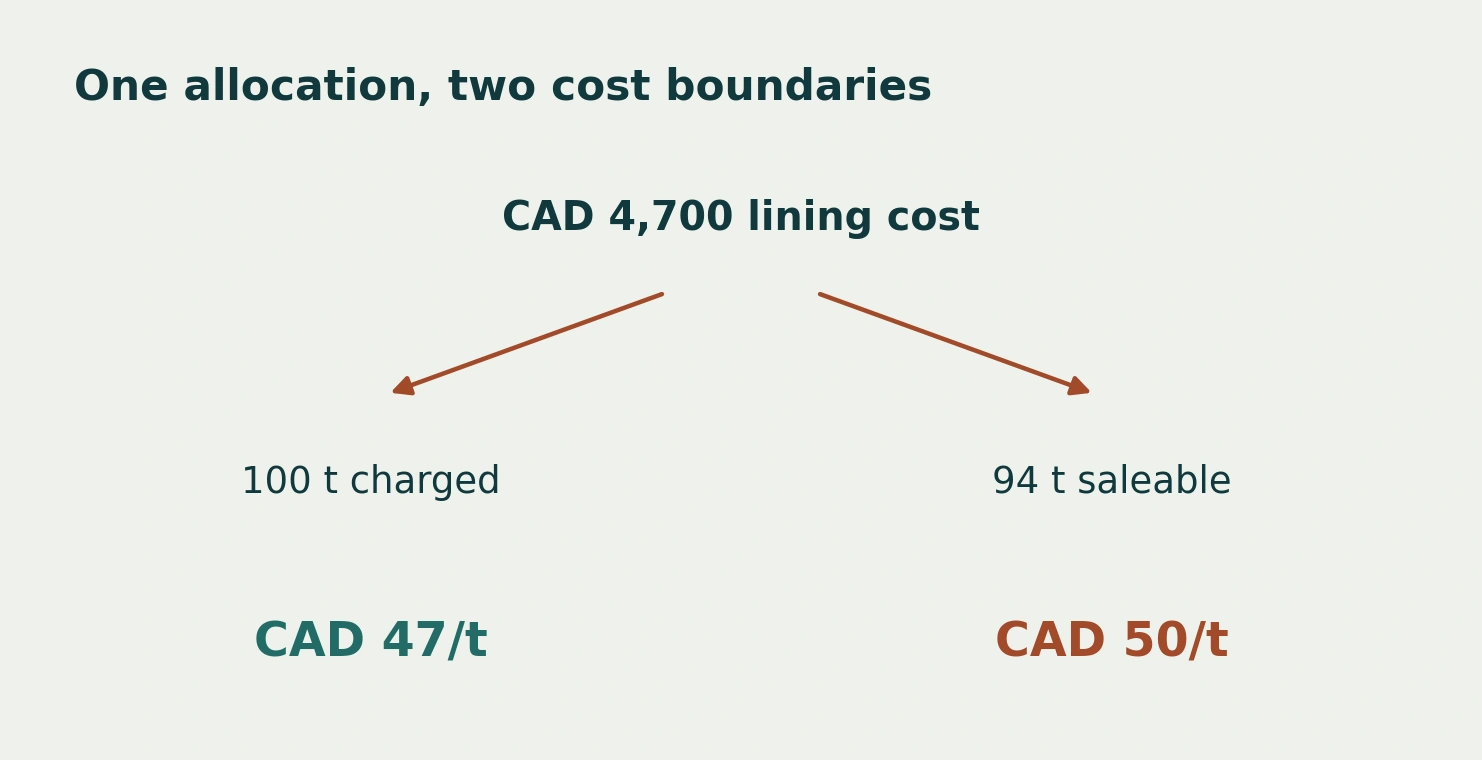
Consider a fictional 100-tonne charge. If 94 tonnes reach saleable product, a CAD 4,700 lining-cost allocation is CAD 47 per charged tonne and CAD 50 per saleable tonne. No brick changed between those calculations. Only the measurement boundary moved. Neither the yield nor the cost is a Cassopolis figure.
The metallurgist may want tonnes of liquid metal in contact with a specific zone. The owner may want cost per shipped tonne. A holding furnace adds another complication: the same metal can spend different amounts of time against the lining, depending on casting demand. The tonnage counter cannot see the extra hours.
Read the nameplate as a question
If someone estimates annual lining cost by multiplying a supplier’s cost per furnace tonne by plant nameplate capacity, ask for the bridge between the two. How many units share the metal? What is the actual product yield? Does internal recirculation pass the same metal through the unit twice?
Try the comparison. Two units deliver identical saleable tonnes, but one holds hot metal much longer. Their business output is comparable. Their thermal exposure may differ substantially. A fair campaign history keeps both hot hours and tonnes against the identified unit.