
Testing and research
Two bricks have the same apparent porosity. What follows?
A useful measurement can leave a selection question open
ASTM C20 covers apparent porosity and other physical properties of burned refractory brick and shapes using boiling water. Suppose two candidate bricks return the same apparent porosity. You have evidence of agreement on one measured property under one method.
The number does not describe the full distribution of pore sizes, the chemistry of either brick or the way each would interact with a particular melt. Two materials can share a reported value and still behave differently in service. Even the question “which brick is better?” is incomplete until the buyer identifies the exposure and the failure they want to avoid.
A stronger technical discussion starts with what the test was intended to resolve. If the purpose was consistency between production batches, the result may be highly informative. If the purpose was forecasting campaign length in a new slag environment, further evidence is needed.
Read the balance before you read the percentage
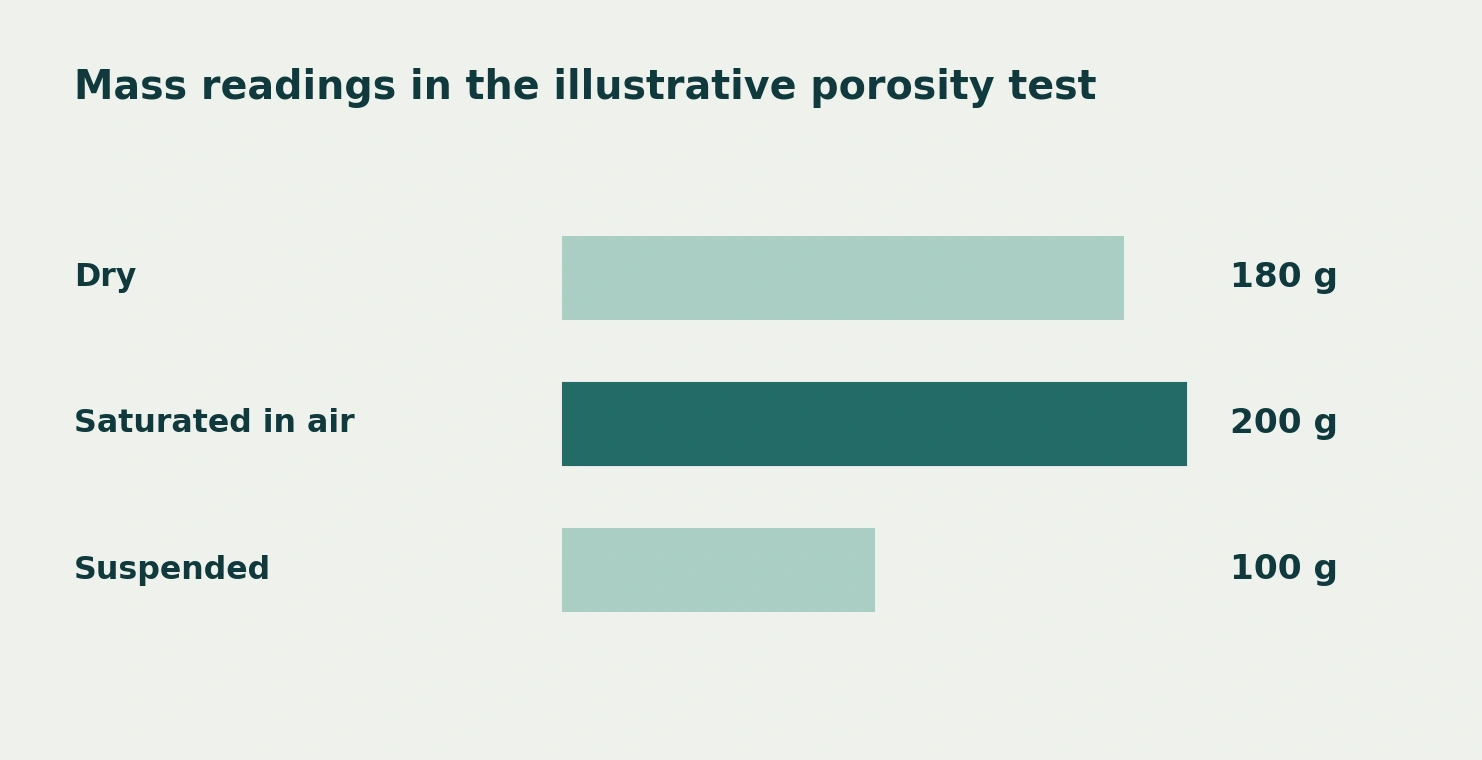
Take a fictional specimen with a dry mass of 180 g, saturated mass in air of 200 g and suspended saturated mass in water of 100 g. The water uptake is 20 g. The 100 g difference between saturated-in-air and suspended readings corresponds to the external volume through buoyancy. Dividing 20 by 100 gives an apparent porosity of 20% under the assumptions of the method. These invented readings illustrate interpretation; consult the standard for the test procedure.
Calculating apparent porosity
Now imagine the saturated-in-air reading is recorded as 199 g. Holding the other two readings fixed, the estimate becomes 19 divided by 99, about 19.2%. A one-gram change moved both the numerator and the denominator. Rounded percentages on competing data sheets can conceal how the result was obtained.
What would you ask the supplier? For a batch-consistency decision, ask for individual results, preparation details and variability across the batch. For a slag-exposure decision, ask what separate evidence connects that brick to the melt chemistry. The same porosity number enters two very different conversations.