
Testing and research
When an abrasion ranking deserves a plant trial
Read the wear mechanism before extrapolating
A candidate metallic liner loses less volume than the reference in a dry sand and rubber wheel test. The ASTM G65 method is designed to compare scratching-abrasion resistance under specified conditions. The word “metallic” matters here: this example concerns wear testing of metallic liners and illustrates reasoning that also matters to refractory researchers.
Two plants receive the same laboratory report. In the first, distributed abrasive thinning usually causes replacement. In the second, isolated impact damage ends service while most of the liner remains thick. The report may justify a bounded comparison in the first plant. For the second, the team must establish whether the tested mechanism affects its decision at all.
The productive disagreement is specific: which damage ended the last campaign, and how closely does the laboratory surface resemble it? That question gives the operator and the researcher something concrete to compare before anyone forecasts service life.
What did the balance really rank?
Consider two fictional metal specimens. A loses 0.78 g and has density 7.8 g per cubic centimetre. B loses 0.72 g and has density 6.0 g per cubic centimetre. By mass B looks better. Converted to volume, A lost 0.10 cubic centimetres, or 100 mm³. B lost 0.12 cubic centimetres, or 120 mm³. The ranking reverses. ASTM G65 reports volume loss, which makes the units part of the engineering argument.
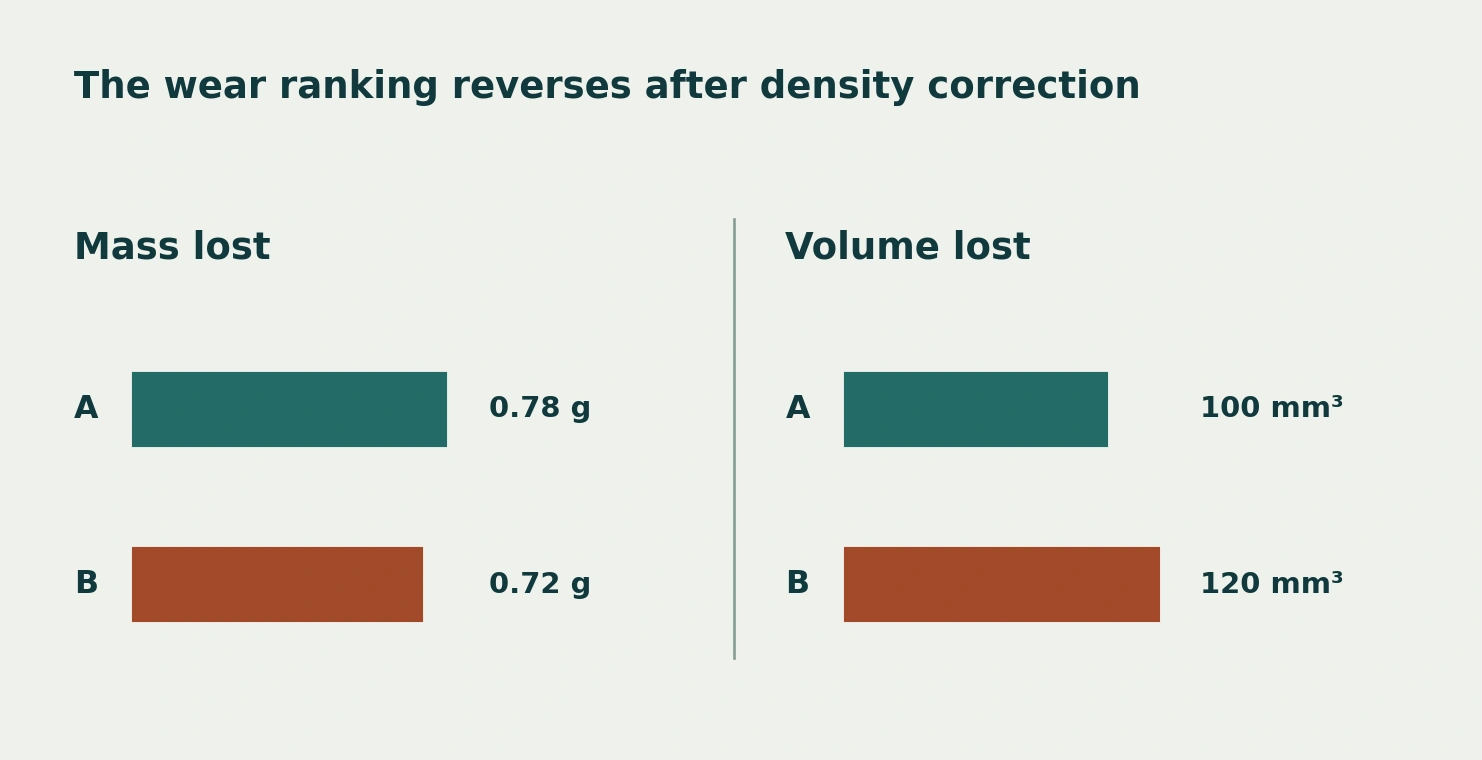
Volume lost by each specimen
Would A now be the correct plant purchase? One result per material tells you little about repeatability. The test also leaves out combinations of loading and impact that may dominate the field. Ask to see the worn surfaces and the spread over comparable runs before translating a difference in volume into a decision.
Change the field evidence. If the reference panel was removed because a bolt-hole edge chipped, ranking scratching-abrasion losses is still a legitimate laboratory result. Its value for that particular changeout decision has just diminished. A good researcher can say exactly which part of the question remains open.