
Damage and diagnosis
Can one buried sensor tell you how much wall remains?
A sensor reads 20 degrees hotter than last week. A cross-section on the control screen paints the corresponding zone thinner. How many of those two statements are measurements?
The study of the fourth campaign at Whyalla No. 2 in Australia combined measured refractory temperatures, operating data and heat-transfer and flow modelling to interpret hearth condition. Its approach illustrates why engineers bring several kinds of evidence to the same reading. The calculated contour and the instrument temperature occupy different places in that chain.
One observation, two possible histories
Imagine two cases. In one, the conductive path through the lining gets shorter. In the other, the wall thickness stays fixed but the thermal conditions on the hot side change. Both can move a buried sensor temperature. A model that allows only thickness to change may return a precise value simply because it has fixed the other explanation in advance.
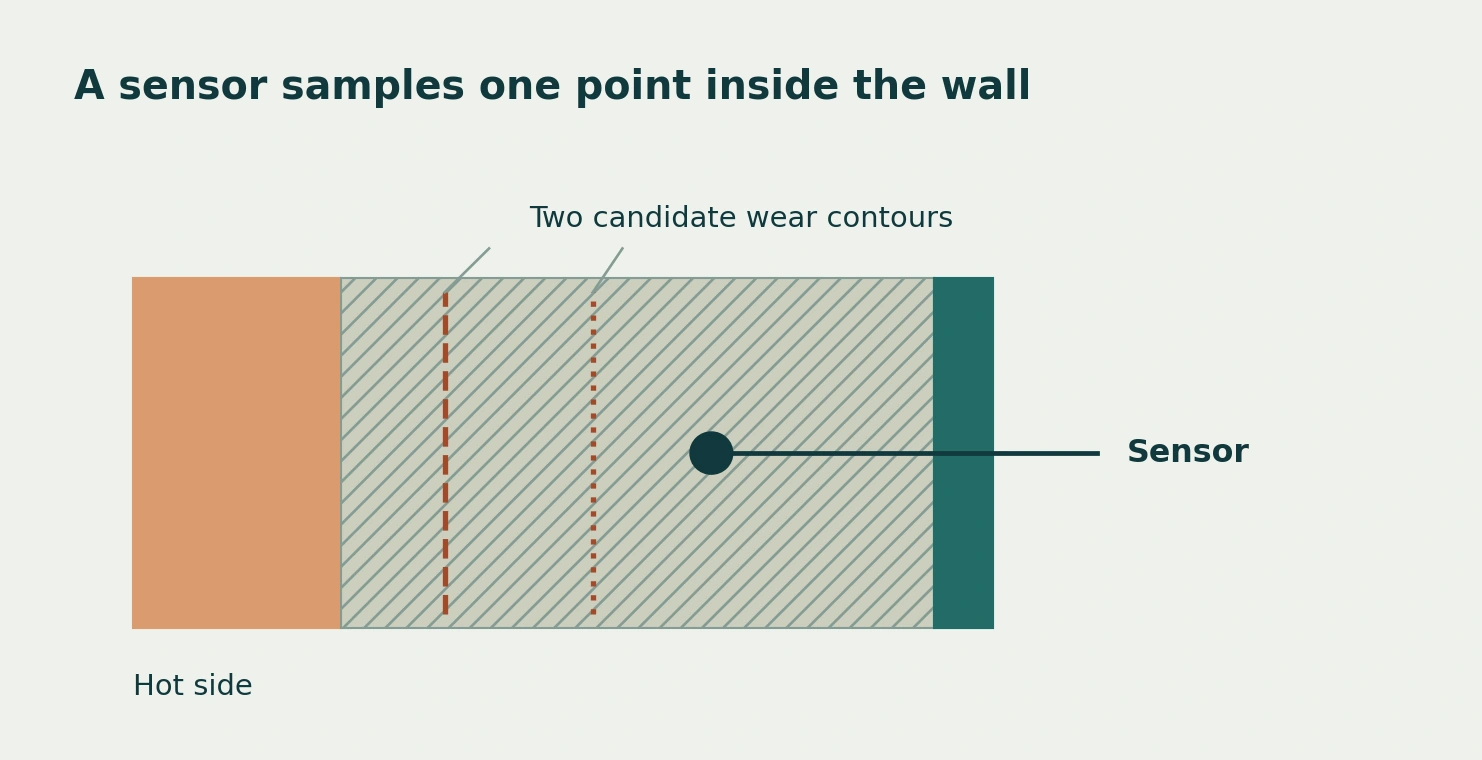
Sensor history → boundary conditions and material assumptions → estimated temperature field → candidate wear contour
Neighbouring instruments and the time history can help discriminate between the two cases. A coordinated shift at several locations after a process change calls for a different discussion from a persistent local departure. Neither pattern, by itself, uniquely identifies wear.
A question to ask at a model review. If two plausible hot-side conditions give different remaining thicknesses while both fit the same sensor, what should appear on the drawing? Show the range and the assumption driving it. That tells the next engineer which observation could narrow the uncertainty.
Primary source
Whyalla No. 2 fourth campaign · published hearth modelling study