
Damage and diagnosis
A pothole in a cathode: what does the cut surface remember?
Stand far enough back from a used carbon cathode and you can map the depressions. Move closer and the surface asks a different question.
Senanu and colleagues examined an aluminium electrolysis cell after 2,461 operating days. Their autopsy found uneven wear across the cathode with potholes, and much smaller shallow pits at a finer scale. They sampled different locations and studied phase composition and microstructure using imaging and microscopy. This is a published research case on a reduction cell, an instructive comparison for people who more often examine furnace linings.
Scale changes the question
A map of the full cell answers “where?” A section through one feature can address “what is present here?” A micrograph from the deepest recess cannot establish how typical that microstructure is across the cathode. Conversely, a smooth average profile can hide the single zone that matters most to the asset owner.
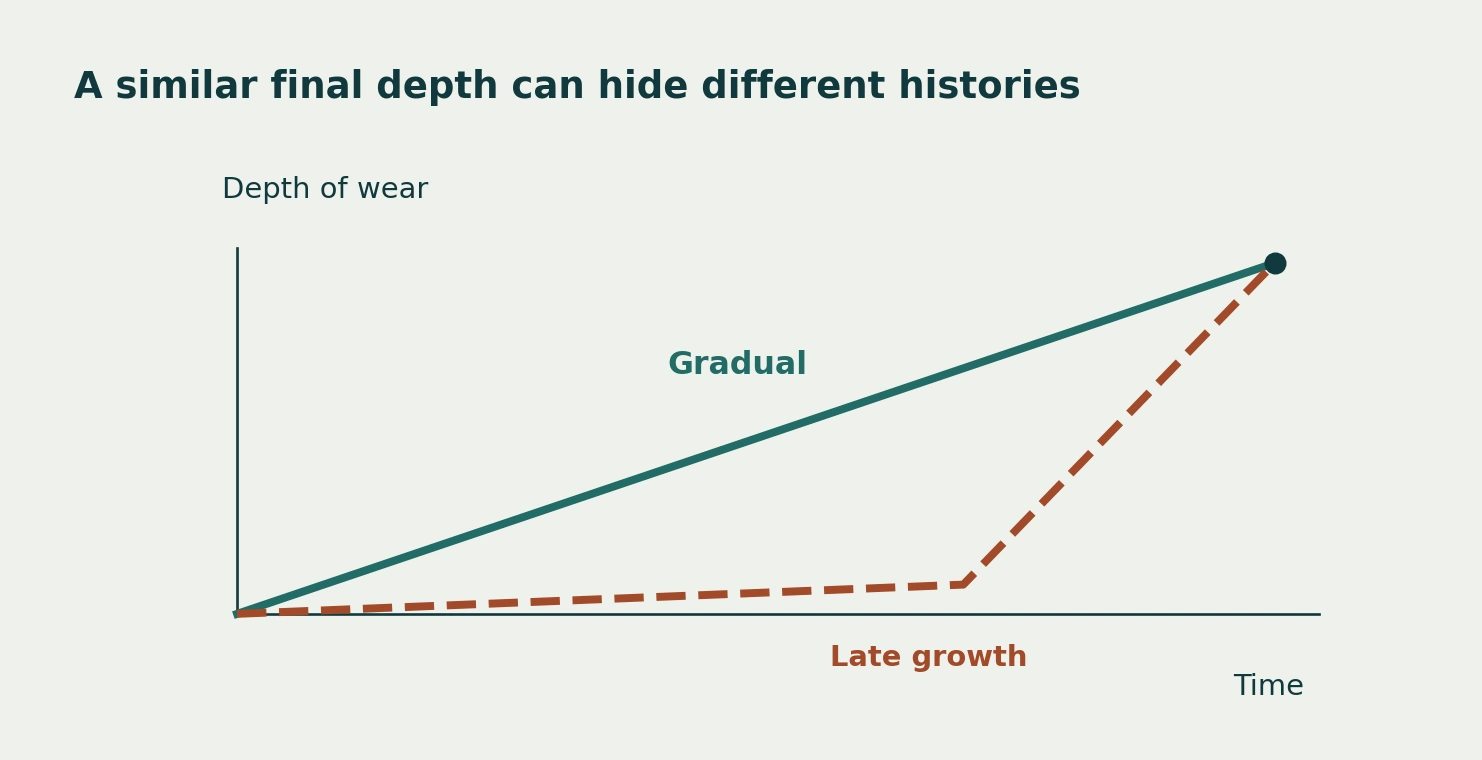
Imagine a second cell with an identical final maximum depth. One depression formed gradually. The other developed late in the campaign. The same final depth divided by the same lifetime gives the same average rate in both examples. Neither average recovers the history. The paper’s 2,461 days date the service period; they do not date the start of an individual pit.
What would change your explanation?
Compare the damaged zone with a less-worn location whose position in the cell is known. If the suspected feature appears in both, its presence alone is a weak explanation for the local difference. If it changes systematically with position, you have a stronger reason to investigate further. That distinction is why the sampling map belongs beside the most beautiful micrograph in the presentation.
Primary source
Senanu and colleagues · autopsy of an aluminium electrolysis cell